



3D Printing Parameters for ZIRO Filament: Complete Setup Guide
When you invest in high-quality filament, you want to achieve the best possible results from your 3D printer. That’s where 3D printing parameters come in — finding the perfect balance between temperature, speed, and cooling is the key to achieving strong, precise, and beautiful prints.
In this guide, we’ll explore the recommended print settings for every ZIRO filament type, based on the official ZIRO 3D Filament Printing Guidance. Whether you’re using PLA PRO, PETG, TPU, Carbon Fiber PLA, or specialty lines like Silky, Matte, or Stone PLA, you’ll find practical tips for every material.
Why Printing Parameters Matter
Each filament behaves differently depending on heat, environment, and printer calibration.
Incorrect settings can cause:
- Weak adhesion between layers
- Warping and lifting from the bed
- Stringing and oozing
- Unwanted glossy or matte finish
Proper tuning of your nozzle temperature, bed temperature, and cooling fan speed ensures the perfect balance of strength, precision, and appearance.
ZIRO Filament Families and Recommended Settings
PLA PRO Filament
Material type: Biodegradable and easy to print — ideal for everyday use.
Recommended settings:
- Nozzle: 190–230 °C
- Bed: 40–60 °C
- Speed: 30–100 mm/s
- Cooling: 80–100 %
- Retraction: 1–3 mm @ 25–45 mm/s
- Drying: 45 °C × 4–6 h
High Speed PLA Filament
Description: A modified PLA formula engineered for high-speed printing up to 600 mm/s with excellent flow and minimal brittleness.
Recommended settings:
- Nozzle: 200–230 °C
- Bed: 40–60 °C
- Speed: 50–600 mm/s
- Cooling: 80–100 %
- Retraction: 0.8–2.5 mm @ 30–50 mm/s
💨 Perfect for fast printers like Bambu Lab and Creality K1.
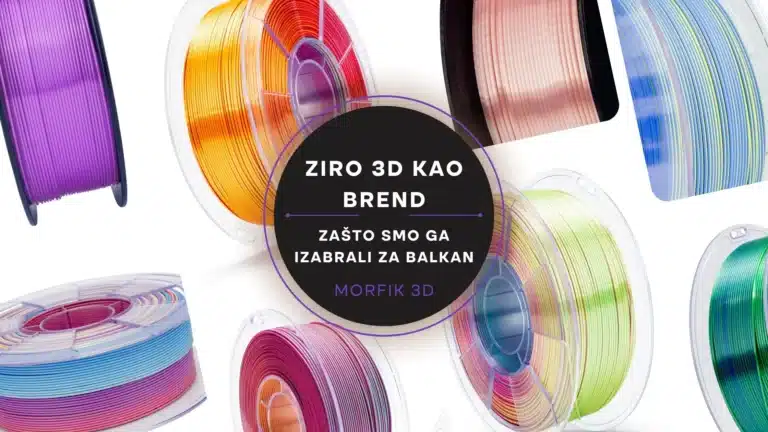
Silky PLA / Gradient Silky / Tri-Color Silky
Description: Glossy, reflective finish for decorative and aesthetic models.
Recommended settings:
- Nozzle: 200–230 °C
- Bed: 40–60 °C
- Speed: 40–70 mm/s
- Cooling: 80–100 %
- Retraction: 1–3 mm @ 25–45 mm/s
💡 Higher nozzle temperatures enhance the shine.
Matte PLA / Gradient Matte / Tri-Color Matte
Description: Low-gloss finish with soft texture that hides layer lines.
Recommended settings:
- Nozzle: 200–230 °C
- Bed: 40–60 °C
- Speed: 40–70 mm/s
- Cooling: 80–100 %
- Retraction: 1–3 mm @ 25–45 mm/s
Perfect for realistic figurines and professional-looking models.
Diamond PLA Filament
Description: Embedded glitter particles create a sparkling finish when exposed to light.
Recommended settings:
- Nozzle: 200–230 °C
- Bed: 40–60 °C
- Speed: 40–70 mm/s
- Cooling: 80–100 %
- Retraction: 1–3 mm @ 25–45 mm/s
- Drying: 45 °C × 4–6 h
✨ Use slightly higher temperature for stronger shine.
Twinkling PLA Filament
Description: PLA blended with shimmering glitter and a translucent base that lets light pass through beautifully.
Recommended settings:
- Nozzle: 200–230 °C
- Bed: 40–60 °C
- Speed: 40–70 mm/s
- Cooling: 80–100 %
- Retraction: 1–3 mm @ 25–45 mm/s
- Drying: 45 °C × 4–6 h
💡 Best for lamps, candle holders, or decorative parts.
Stone PLA Filament
Description: PLA composite infused with mineral powder, resulting in a stone-like matte finish.
Recommended settings:
- Nozzle: 200–230 °C
- Bed: 40–60 °C
- Speed: 40–70 mm/s
- Cooling: 80–100 %
- Retraction: 1–3 mm @ 25–45 mm/s
- Drying: 45 °C × 4–6 h
Perfect for sculptures, architectural models, and decor items.
Mystical PLA Filament
Description: A magical mix of colors with subtle shimmer and deep transitions — dreamlike appearance.
Recommended settings:
- Nozzle: 190–230 °C
- Bed: 40–60 °C
- Speed: 40–70 mm/s
- Cooling: 80–100 %
- Retraction: 1–3 mm @ 25–45 mm/s
- Drying: 45 °C × 4–6 h
🌠 Great for dragons, figurines, and other visually striking models.
Carbon Fiber PLA Filament
Description: Reinforced with carbon fibers for high rigidity and a matte, textured surface.
Recommended settings:
- Nozzle: 200–230 °C
- Bed: 40–60 °C
- Speed: 40–70 mm/s
- Cooling: 50–80 %
- Retraction: 1–3 mm @ 25–45 mm/s
- Drying: 45 °C × 4–6 h
⚙️ Always use a hardened steel nozzle — carbon fibers wear down brass nozzles quickly.
🧱 PETG Filament
Description: Strong, industrial-grade PETG with excellent layer adhesion and dimensional stability.
Recommended settings:
- Nozzle: 240–260 °C (≈250 °C recommended)
- Bed: 100–120 °C
- Speed: 40–60 mm/s (1st layer 20–30 mm/s)
- Cooling: 0–30 % (1st layer), 40–60 % afterward
- Retraction: 1–3 mm @ 25–45 mm/s
- Drying: 65 °C × 4–6 h
💧 Use higher bed temperature to prevent warping.
TPU Filament
Description: Flexible and durable, ideal for soft-touch and impact-resistant parts.
Recommended settings:
- Nozzle: 200–230 °C
- Bed: 40–60 °C
- Speed: 20–50 mm/s
- Cooling: 30–50 %
- Retraction: 0.5–2 mm @ 20–30 mm/s
- Drying: 45 °C × 6 h
⚙️ Use a direct drive extruder and disable excessive retraction.
ABS Filament
Description: Durable thermoplastic for functional parts with excellent mechanical strength.
Recommended settings:
- Nozzle: 210–250 °C
- Bed: 90–110 °C
- Speed: 40–70 mm/s
- Cooling: 0–20 %
- Drying: 65 °C × 6 h
🏗️ Enclosed chamber recommended to prevent warping.
☀️ ASA Filament
Description: UV-resistant material, perfect for outdoor applications like housings, brackets, and signage.
Recommended settings:
- Nozzle: 210–250 °C
- Bed: 90–110 °C
- Speed: 40–70 mm/s
- Cooling: 0–30 %
- Drying: 60 °C × 6 h
☀️ ASA offers color stability and weather resistance.
⚙️ Avoid These Common Mistakes
- Overcooling can reduce strength for PETG and TPU.
- Under-cooling causes dull finishes on Silk PLA.
- Always dry filament before printing — moisture creates bubbles and poor layer adhesion.
- Adjust your retraction speed and distance to minimize stringing.
- Experiment gradually: every printer, environment, and nozzle behaves slightly differently.
📘 Conclusion
Each ZIRO filament has its own character — learning to adjust your 3D printing parameters helps you achieve consistent, professional-quality results. Whether you need durability, flexibility, or eye-catching color effects, ZIRO offers a reliable option for every use case.
For the full technical chart, download the official PDF:
👉 ZIRO 3D Filament Printing Guidance (PDF)